
Erdoğan's Toolkit
Four ideological traditions, six attached customers, one missile in Hall 3 — and a country that stopped pretending to choose.

“He who controls the past controls the future. He who controls the present controls the past.” — George Orwell
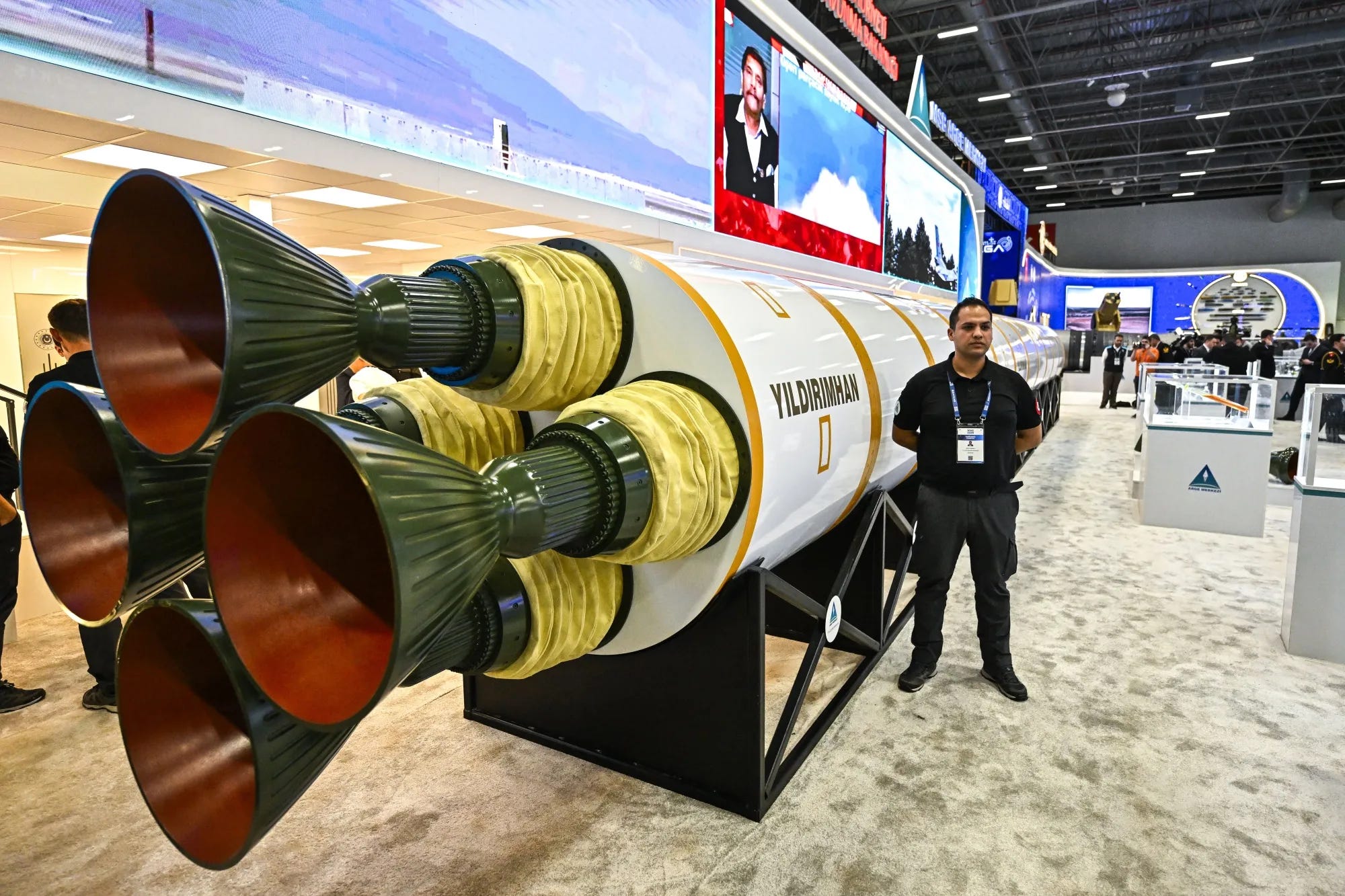
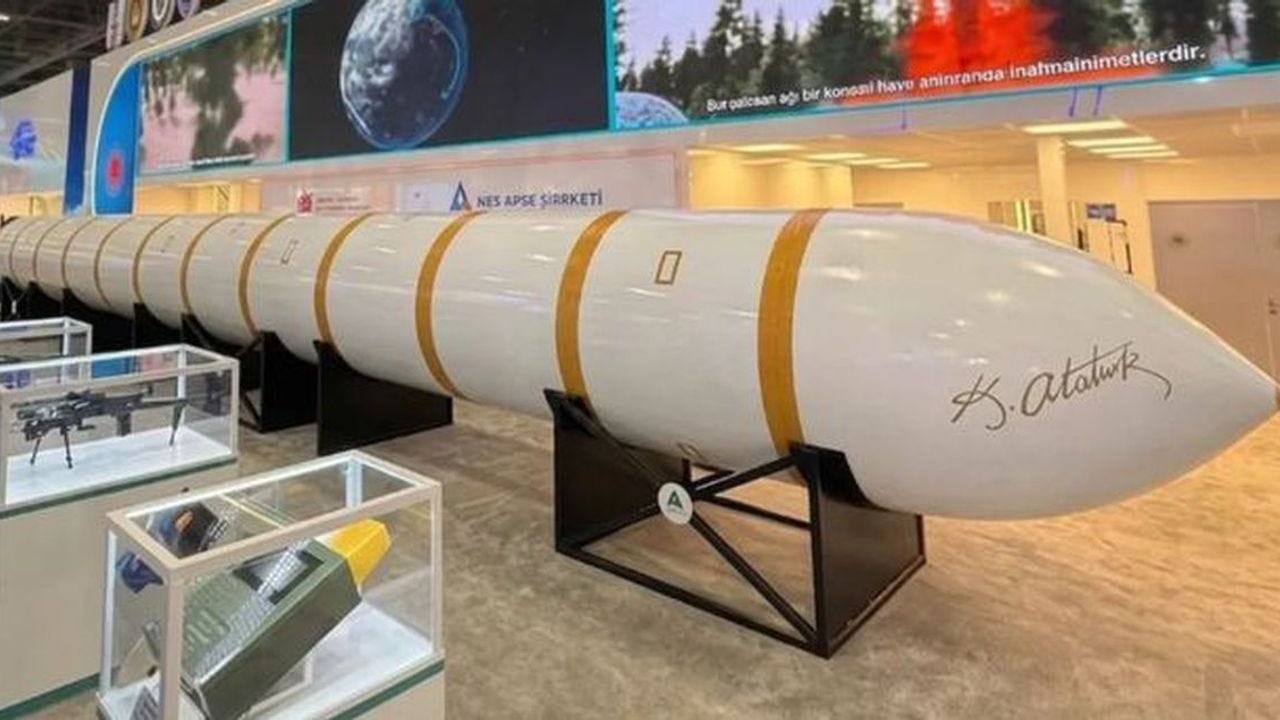
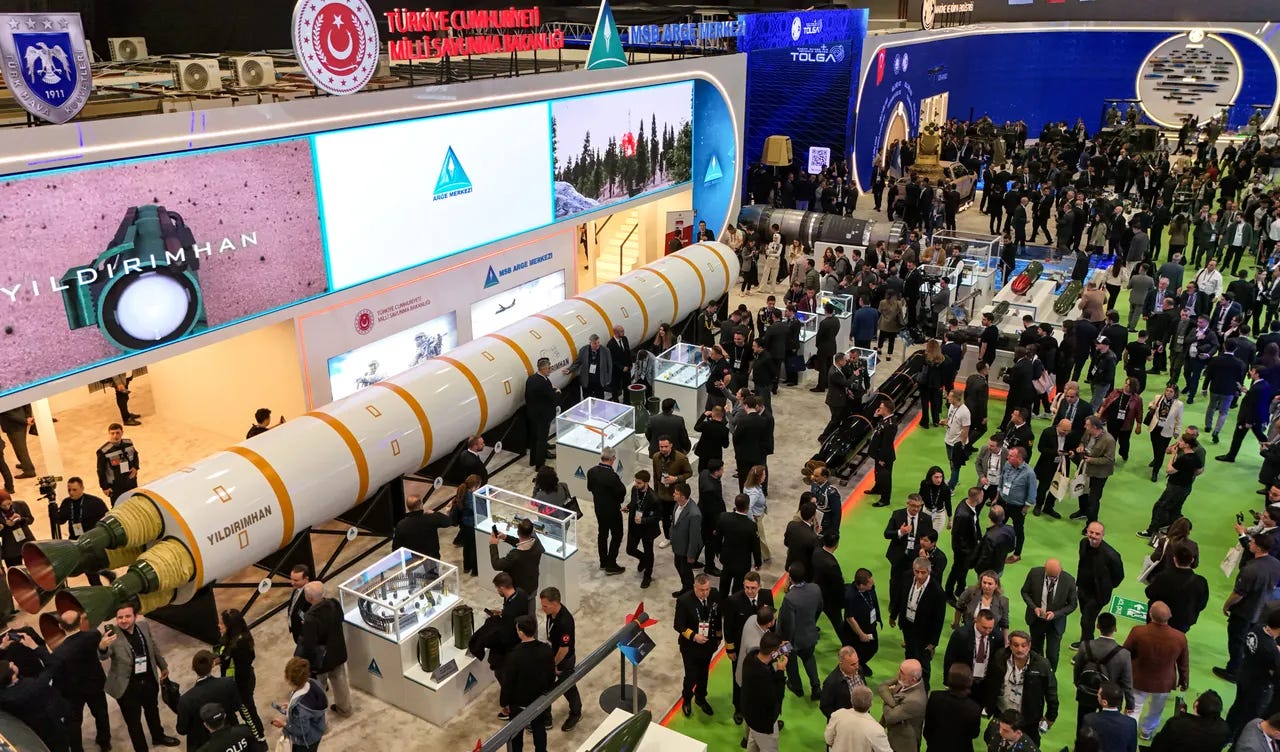
A 15-metre missile model stood at the centre of Hall 3 of the Istanbul Expo Centre on Tuesday, 5 May. Anadolu’s wires called it Yıldırımhan — Lightning Khan, after an Ottoman sultan. The technical placard at its base listed a 6,000-kilometre range, a 3,000-kilogram payload, and four liquid-fuelled rocket engines burning nitrogen tetroxide.
Turkey does not have nuclear warheads.
Nuclear warheads are what 6,000-kilometre missiles normally carry.
That is the headline. The story underneath it is older.
For roughly seventy-five years, the West has read Turkey through a binary lens.
Either Ankara is inside the tent — NATO frontier state, customs-union counterparty, EU candidate, Incirlik host — or it is drifting out of it, towards Moscow, Beijing, the SCO, the BRICS, the Sunni-Islamic bloc nobody can quite name.
Whichever side of that read you sit on, the lens itself is wrong.
Turkey is not drifting. Turkey is not ambiguous.
Turkey is doing something the binary lens cannot see, because the binary lens was designed for a unipolar world that ended somewhere between the Iraq invasion and the assassination of Ali Khamenei on 28 February of this year.
What the binary lens misses is the toolkit.
Erdoğan does not operate from a single doctrine.
None of them is the policy. The composite is the policy.
And the composite, once you read it correctly, has a name.
Ahmet Davutoğlu wrote it in 2001. Merkez ülke. Central state.
This article is about what that has looked like in operational terms over the last ten weeks.
The Iran war broke out on 28 February.
The Strait of Hormuz has been effectively closed for seventy-two days.
Brent settled at $101.29 on Friday.
The IEA estimates that 14 million barrels per day of global supply remain dislocated.
The US naval blockade of Iranian ports entered its fifth week on Wednesday.
NATO will meet in Ankara on 7-8 July. Erdoğan is preparing his second Gulf swing of the year. The Saudi-Pakistan Strategic Mutual Defence Agreement, signed on 17 September last year, is being renegotiated to admit a third party.
And seven days ago, Turkey unveiled an intercontinental ballistic missile.
None of these things are independent. All of them are the same trade.
Let me show you.
The Author and His Tools
There is a temptation, when writing about Turkish foreign policy, to reach immediately for either ideology or pragmatism — to argue that Erdoğan is either a true-believing Islamist or a transactional opportunist, and to frame everything else as decoration.
Both readings are wrong.
Both readings miss the structure.
I want to push that argument one step further than the MEI piece does.
The composer’s freedom is not unbounded.
Erdoğan can reach into the Kısakürek tradition for a leader-centric populist register, into Erbakan’s Milli Görüş for the language of Muslim industrial self-reliance, into Davutoğlu for the merkez-ülke frame, into the Eurasianist-leaning Mavi Vatan for the encirclement narrative — but he cannot use them in any combination he likes.
The toolkit imposes a constraint structure.
Erbakan’s self-reliance argument, once you commit to it, requires a defence-industrial base.
Davutoğlu’s central-state argument, once you commit to it, requires that you not be absorbed by any single bloc.
Mavi Vatan, once you commit to it, requires that you contest the maritime claims of Greece and Cyprus.
Each tradition the composer draws from binds him further.
This is what makes the toolkit argument interesting.
The output of Erdoğan’s coalition-management exercise — the AKP plus the ultranationalist MHP plus the Eurasianist networks embedded in the security services after 2016 — looks improvisational from the outside.
It is not → It is path-dependent.
It is the trajectory you get when the composer commits to four traditions at once and then has to honour the implicit promises each of them makes.
The 2019 maritime delimitation deal with Libya’s Tripoli government is Mavi Vatan, executed.
The Astana Format with Russia and Iran is Davutoğlu, executed.
The Hamas dialogue, the Muslim Brotherhood backing in Egypt and Tunisia in 2011-13, the diplomatic pivot to Doha during the GCC blockade — all of it is Kısakürek’s authentic-Muslim-public framing operating in the foreign policy domain.
Each move is legible to one tradition; the composite is only legible if you read all four at once.
The reason this matters for what follows is simple.
When Western analysts argue that Erdoğan is bluffing — that the BRICS application is a signalling exercise, that the SCO dialogue partnership is performative, that the trilateral defence talks with Riyadh and Islamabad will not survive contact with NATO obligations — they are reading the moves through a single tradition.
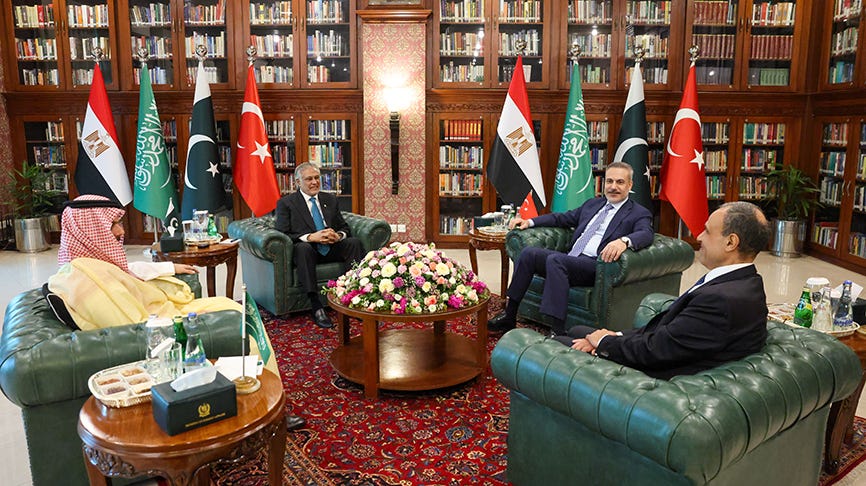
They are reading Erdoğan as a Western leader pretending to be a Eurasianist, or a Eurasianist pretending to be a Western ally, and concluding that one of the two pretences must collapse.
Neither will.
The toolkit is the doctrine.
The composer is committed to all of it.
The Hybridity Premium
Jeffrey Mankoff and Max Bergmann’s CSIS brief from December — Strategic Ambiguity — frames Turkey as a hedging middle power that monetises its position at the seam.
I want to take that frame and price it.
A hedge has a cost.
Hedging premiums in any market exist because counterparties are willing to pay for the option not to commit.
In a unipolar order, hedging Turkey-style does not work because there is only one sun, and gravity points in one direction.
In a multipolar order, hedging works precisely because each pole pays for the option of not losing you to the other one.
That is the fee Turkey collects.
Not a discount on F-16s.
Not a Saudi central-bank deposit.
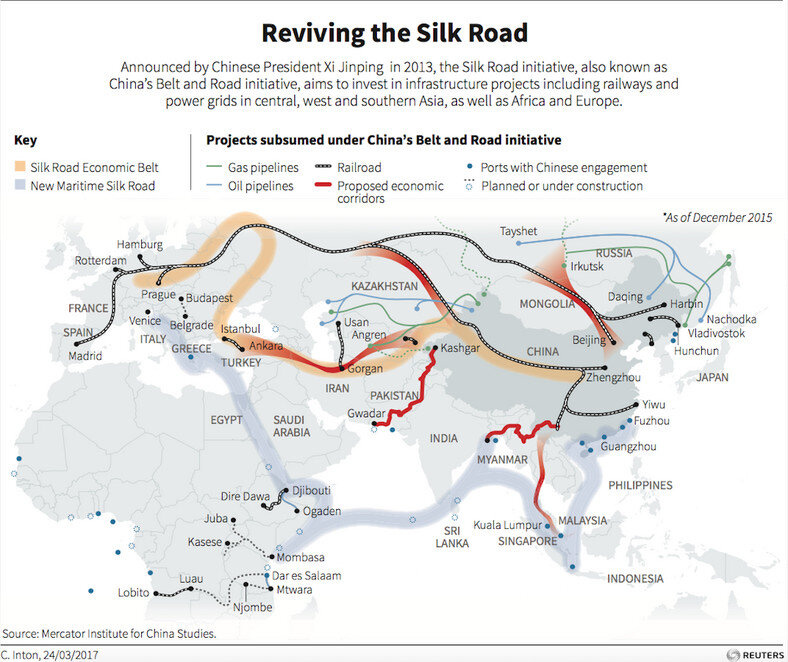
The fee is the structure of the relationship — the fact that Washington, Brussels, Moscow, Beijing, Riyadh, Tehran, Doha, Abu Dhabi, Cairo, and Jerusalem all maintain a working channel with Ankara because the cost of letting that channel close is higher than the cost of indulging the ambiguity.
Look at what each customer is paying.
Brussels is paying with the migration deal originally cut in 2015 and quietly extended in every iteration since, plus the customs union nobody has the political appetite to terminate.
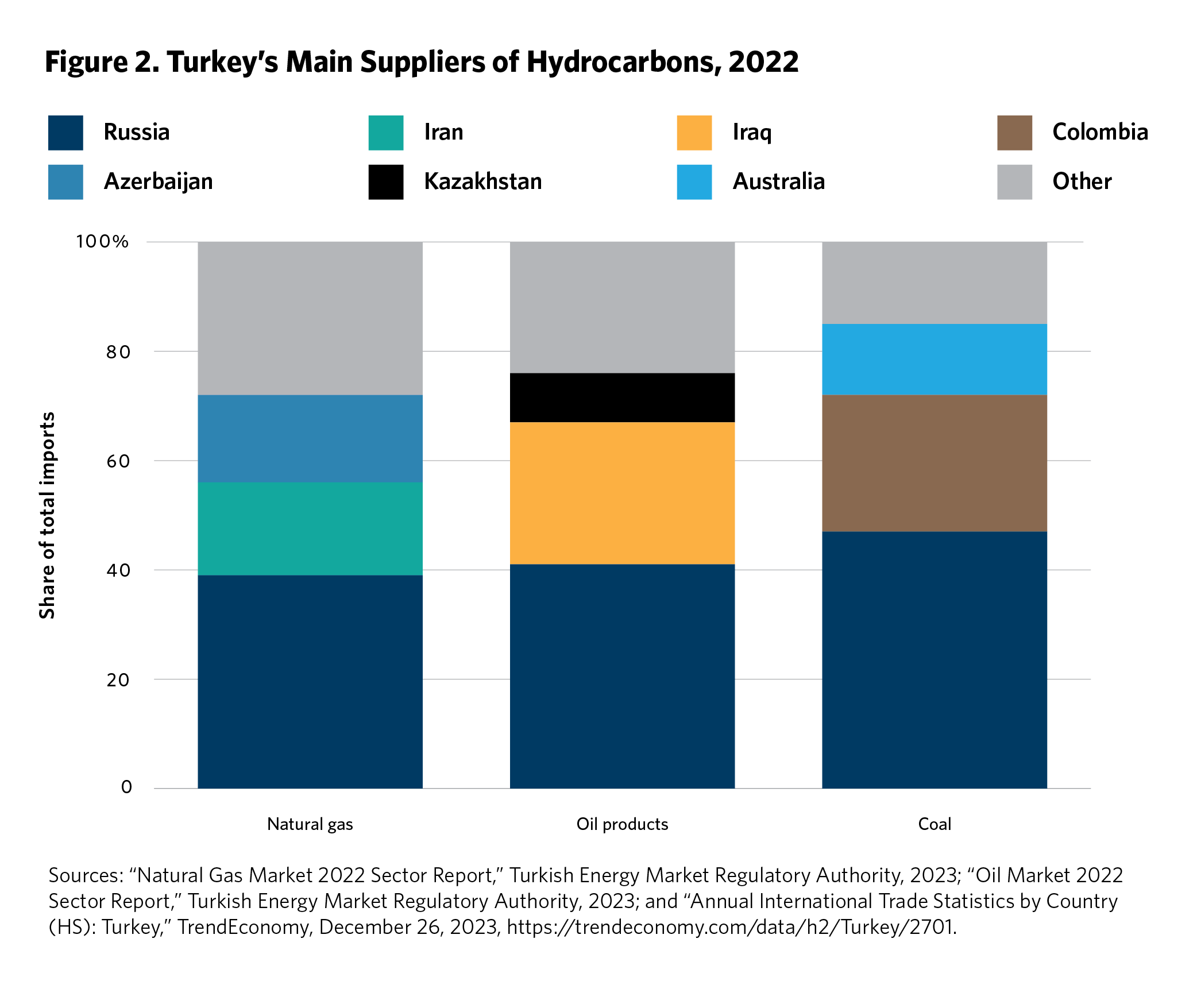
Moscow is paying with discounted gas through TurkStream and Blue Stream — Russia currently supplies 40-42% of Turkey’s natural gas imports, anchored by extended contracts running through end-2026 — plus Rosatom’s $20 billion Akkuyu nuclear build, whose first reactor goes critical this year.
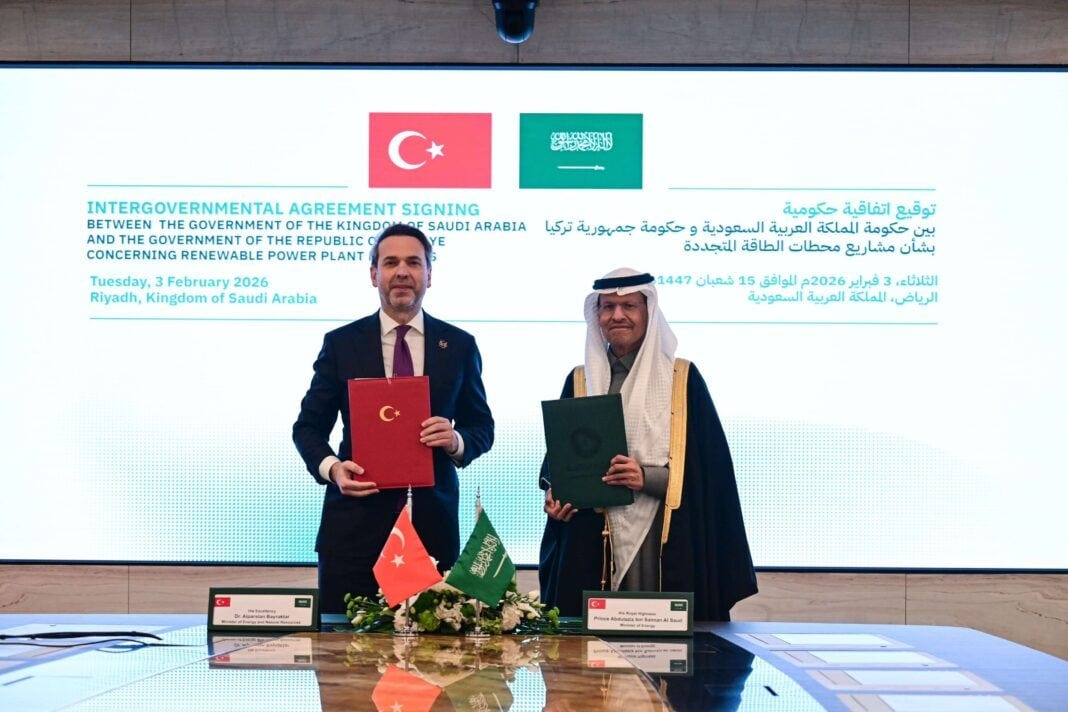
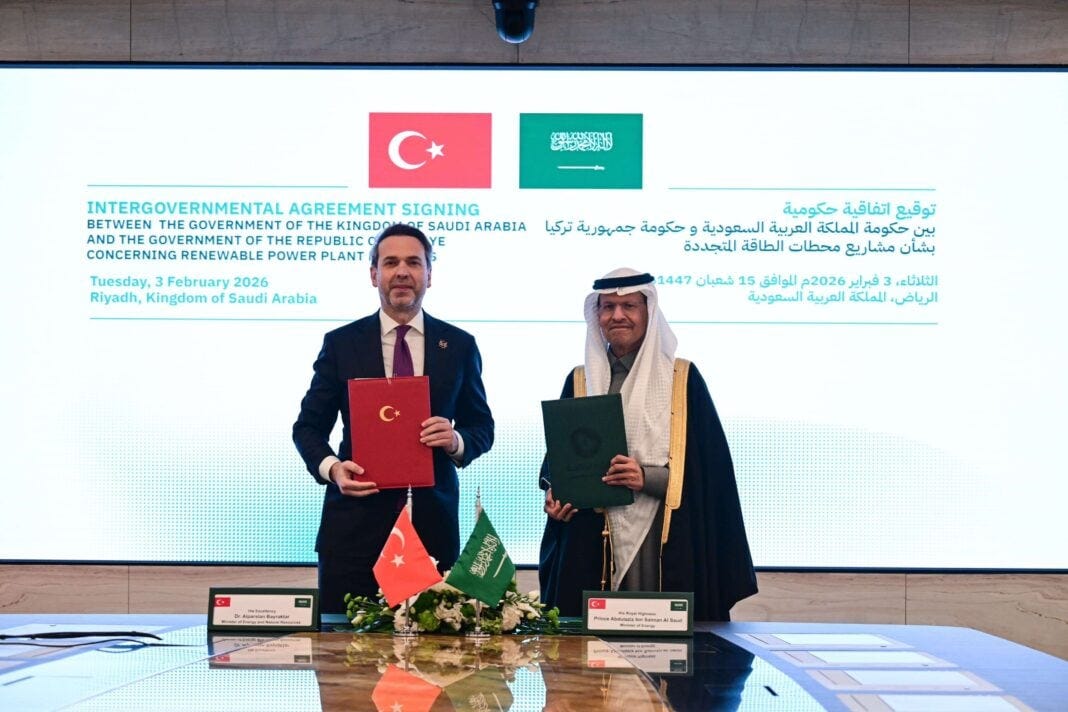
Riyadh paid in February with two solar plants, $2 billion in investment, and a free-trade-agreement framework with the GCC.
Tehran pays with conditional restraint on PKK-linked activity in northern Iraq and a tacit agreement to manage the Kurdish file as a regional condominium.
Jerusalem pays — even now, even with relations near the worst point in fifty years — by maintaining the back-channel that the Mossad has not severed.
The fee is not symmetric. Some customers pay more than others.
The point is that all of them pay something, all of them keep paying, and the income stream is the strategic position itself.
This is why the standard Western analytical frame, which treats Turkey’s choices as a series of binary loyalty tests, breaks down.
Erdoğan is not failing the loyalty tests.
Erdoğan is selling the option not to take them.
The customs union is not a contradiction with the BRICS application.
The S-400 is not a contradiction with NATO’s Article 5.
The Hamas dialogue is not a contradiction with the seat on Trump’s Gaza Board of Peace.
Each of these pairings is the product itself. The product is unambiguity for everyone except the person reading the contract from outside.
What Mankoff and Bergmann correctly note — and what every honest analyst since Davutoğlu has had to concede — is that the strategy has a structural ceiling.
Turkey’s profound economic dependencies on Western capital markets, NATO’s nuclear umbrella, the dollar payment system, and Western tourism revenue place a hard limit on how far the hedge can be stretched before it tears.
That ceiling has held since 2002.
Whether it holds through the next decade is the open question this piece will close on. But for now, on 11 May 2026, the hedge is paying.
The income is real — The customer list is intact — The toolkit is solvent.
The Iran war added a customer.
The War That Arrived
I have been writing about the Strait of Hormuz since the first week of March.
The Same Room (3 May) walked through Bassam Fattouh and Andreas Economou’s OIES paper on the regime break.
Kilian Picks Up the Pencil (17 April) framed the Dallas Fed inflation pricing of the closure scenarios.
The Battle-Tested Stack (8 April) covered the AI-targeting architecture inside Operation Epic Fury.
None of those pieces were primarily about Turkey.
This one is.
Gönül Tol’s 16 April Middle East Institute commentary — Turkey Sees Short-Term Pain, Long-Term Gain in the Iran War — is the cleanest single document that anyone has written about how Ankara reads the war.
I want to engage with it directly, because the Tol piece identifies four openings Turkey is moving on, and I want to argue that all four are versions of the same trade — and that the trade is reflexive in the strict Soros sense.
Reflexivity, briefly, because it matters here.
Soros’s claim is that in markets with thinking participants, the participants’ perception of the fundamentals shapes the fundamentals themselves.
There is no equilibrium between perception and reality.
There is feedback.
Perceptions shift the world the perceiver is trying to perceive, and the world then shifts the perception. Bubbles inflate not because investors are wrong about prices but because investors believing prices will rise causes prices to rise.
The thinking participant changes the system by participating in it.
The Iran war is doing this to Turkey’s regional position right now.
The first opening Tol identifies is the energy-hub ambition.
Erdoğan has been pitching Istanbul as the gas crossroads of Eurasia for the better part of two decades.
Until 28 February, the pitch was structurally hollow because the alternative routes — the Saudi East-West pipeline, the UAE’s ADCOP to Fujairah, the Qatari undersea grid — all bypassed Turkey, while the Strait of Hormuz handled twenty million barrels a day and there was no reason to need overland.
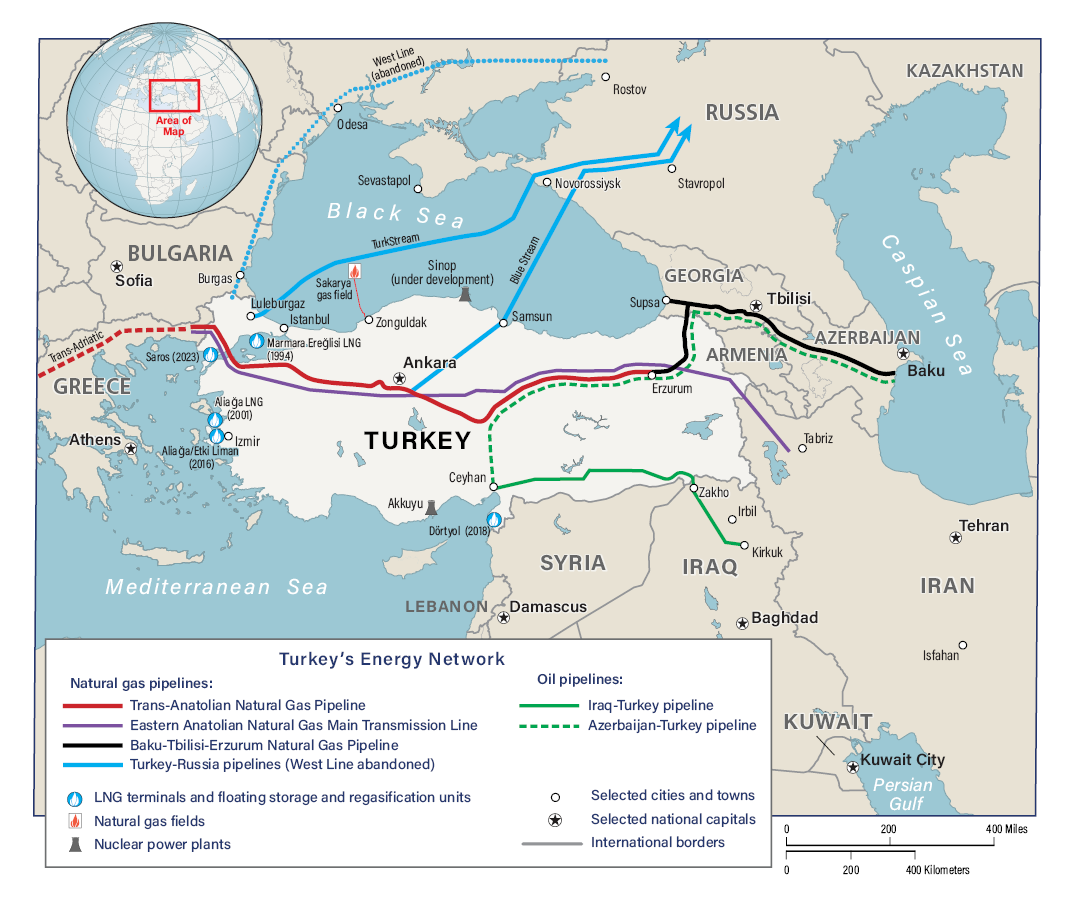
The closure has rebuilt the case from the demand side. With Hormuz dark and the Gulf monarchies actively shopping for non-maritime crude routes, the Iraq Development Road from Basra and the Kirkuk-Ceyhan reactivation suddenly have customers willing to underwrite the financing.
Energy Minister Bayraktar’s October pitch in Moscow about Azerbaijani gas through TANAP and TurkStream’s surge to 10 bcm in H1 2025 was forward-looking.
The post-28 February pitch is reactive — Turkey is the pipeline that already exists, and the Gulf needs pipelines.
The second opening is defence exports.
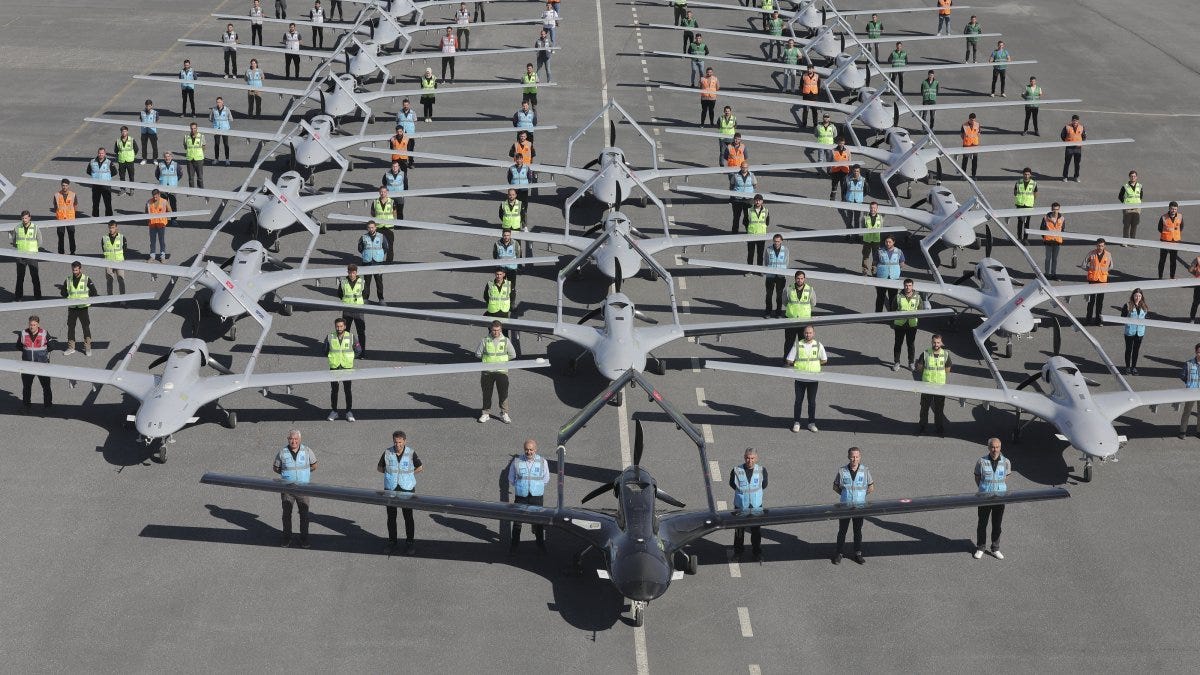
Tol notes that Saudi state defence firm SAMI is now in localisation talks with Baykar and Aselsan. Turkey’s largest-ever defence export deal, signed during Erdoğan’s 3 February Riyadh visit, was for Bayraktar Akıncı UCAVs and is being expanded to include warships, tanks, missile systems, and partnership in the Kaan fighter programme.
The UAE relationship is moving into joint projects between Baykar and EDGE.
Qatar is anchored by the Turkish base.
The Gulf customers are not shopping.
The buyers are reading that delta as a marketing document.
The IMEC bypasses Turkey by design.
The Iraq Development Road runs through Turkey by design.
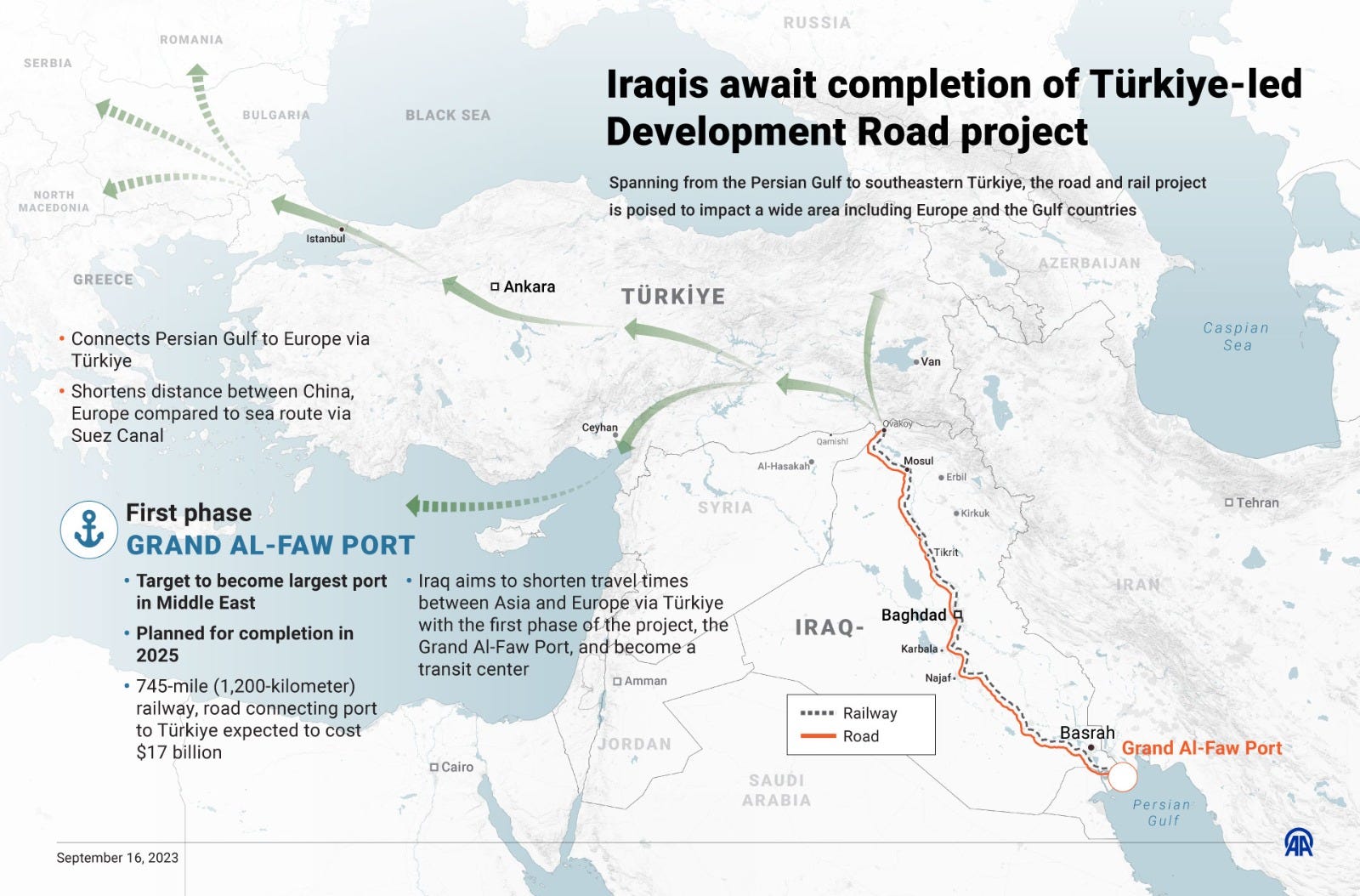
The war has not closed IMEC, but it has made the Red Sea route look unattractive to insurers and shippers — which means the corridor competition is no longer between two viable routes; it is between one disrupted route and one Turkish-anchored alternative whose construction has been accelerated by both Iran’s weakening hand inside Iraq and the visible costs of maritime exposure.
The fourth opening is Istanbul as a financial centre.
I am sceptical of this one.
Turkey’s politicised courts and erosion of the rule of law are real, and capital does not move into a venue where contract enforcement depends on the political mood of the executive. But the directional point holds: the Gulf’s branding as the region’s neutral financial hub took damage on 28 February, and Istanbul does not need to win the relocation race outright — it only needs to be in the conversation.
Now apply the reflexivity framework.
Turkey’s perception that the war creates a hub opportunity is itself causing capital, infrastructure, and diplomatic attention to flow toward Ankara.
The flow is shifting the underlying economic and strategic geography.
The shifted geography then justifies further perception of opportunity.
The Saudi solar investment is signed because Erdoğan is positioning Turkey as energy-relevant. Turkey is positioning Turkey as energy-relevant because the Saudi investment is signed.
The pipeline financing happens because the corridors are being built.
The corridors are being built because the financing is happening.
This is the loop.
It does not stabilise.
It runs until something external breaks it — either a Hormuz reopening on terms favourable to the Gulf, in which case the case for Turkey collapses partially, or a settlement that leaves the disruption permanent, in which case the case becomes structural.
The reflexive loop has weeks of runway, possibly months.
What Erdoğan understood — and what most Western capitals did not — is that the moment the war started, Turkey stopped being one of several regional middle powers competing for relevance.
Turkey became the only one whose physical geography, infrastructure base, and political channels were positioned to absorb the displaced flows.
The opportunity did not come from Turkish strategy.
The opportunity came from Hormuz closing.
Turkish strategy is the response — and the response is creating its own gravity.
What Doesn’t Get Signed

I want to argue that the most informative thing about this episode is not what got signed but what did not.
The SMDA in its bilateral form is a Saudi-Pakistani arrangement.
Whatever the precise legal scope, the SMDA does what bilateral defence treaties do: it forecloses optionality. It commits Riyadh to come to Islamabad’s defence if India strikes; it commits Islamabad to come to Riyadh’s defence if Iran strikes.
Both commitments are exclusive.
You cannot have a NATO-style mutual-defence umbrella and also be neutral.
Turkey, having participated in months of trilateral discussions, ultimately did not sign because signing would have collapsed the hybridity premium.
A binding mutual-defence commitment to Saudi Arabia and Pakistan would have foreclosed Turkey’s optionality with Iran, with the Houthis, with Egypt’s parallel defence-coalition initiative under the 1950 Joint Defence and Economic Cooperation Treaty, and — most importantly — with Greece, whose maritime claims sit at the centre of Mavi Vatan and whose defence relationship with India is precisely the Indian relationship Pakistan would expect Turkey to position against.
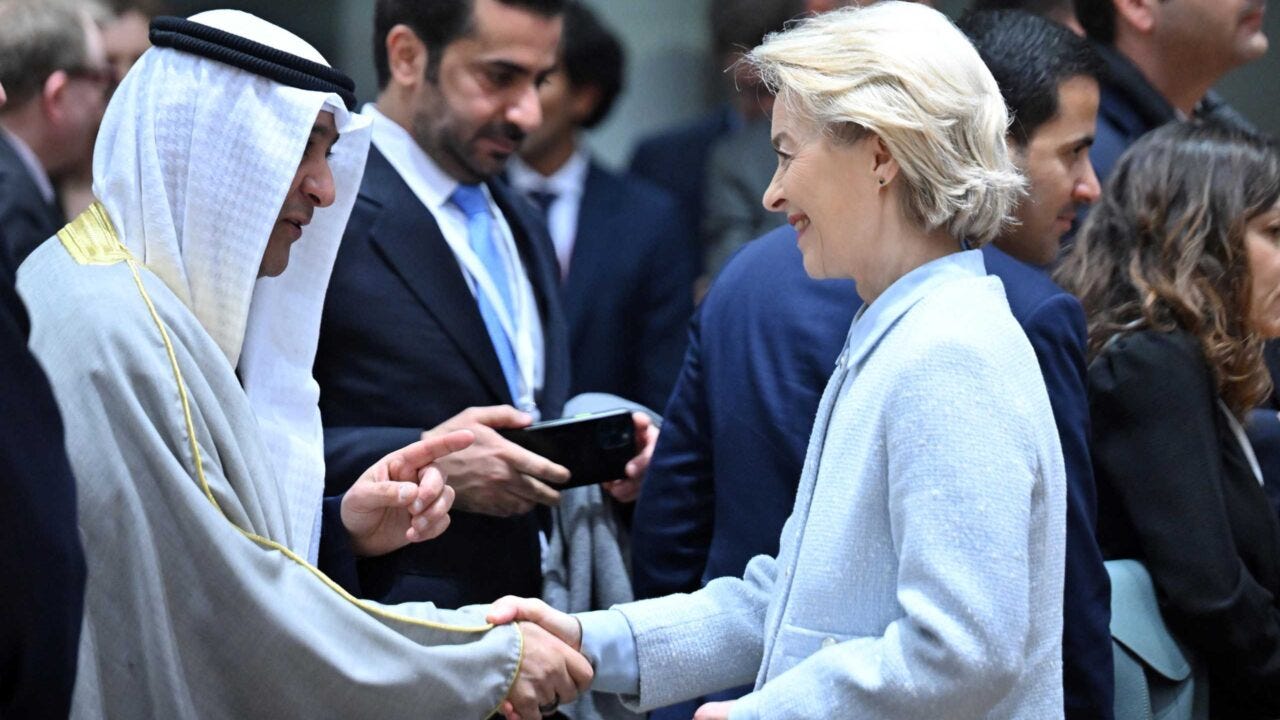
What Foreign Minister Hakan Fidan told TRT in mid-January is the operative line. “Our President Recep Tayyip Erdoğan’s vision is for an inclusive platform that creates wider, bigger cooperation and stability.”
Platform, not pact. Cooperation, not commitment. Inclusive, not aligned.
The vocabulary is exact.
That is the model Turkey will sign.
That is the model Turkey will not.
The same logic explains why Turkey expressed interest in Egypt’s proposed Arab defensive force under the 1950 treaty in September of last year, why the Gulf states (mainly Qatar and the UAE) blocked it, and why Cairo and Ankara have been quietly rebuilding their bilateral channel since. The blocked Egyptian initiative would have done what the SMDA does — formalise commitments, foreclose optionality. Turkey would have lost from joining it for the same reason it lost from joining the SMDA.
This is the platform Fidan referred to.
This is what the Damascus war-room initiative in March was trying to be.
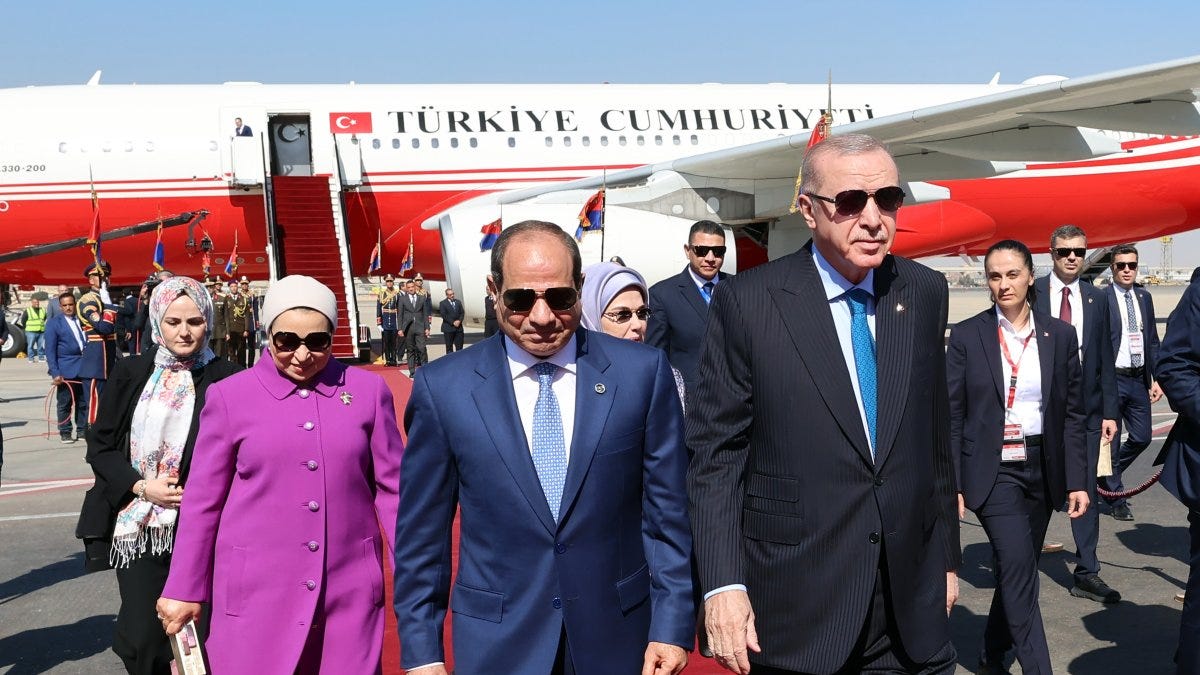
This is what the Erdoğan-Sisi-MBS-Sharif foreign ministers’ meeting on the sidelines of the OIC on 19 March in Riyadh was scoping. This is what the SETA Foundation calls “deepening military cooperation… not as a NATO-like pact, but as a defence cooperation mechanism that could eventually include Pakistan and Saudi Arabia.”
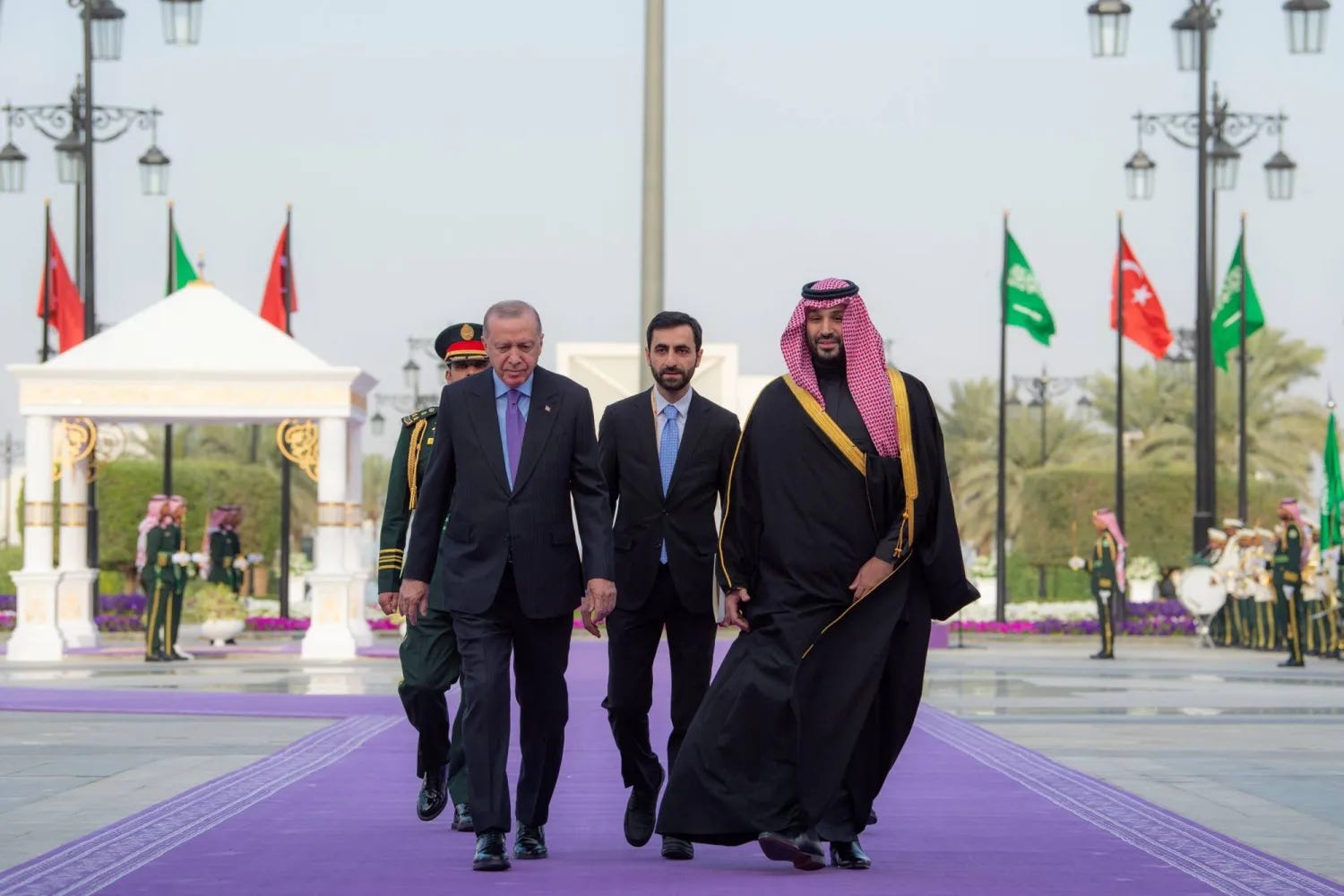
That read is wrong in form but right in direction.
The architecture is not a bloc.
It is a platform.
But its existence does what blocs do without the binding commitments — it raises the cost of acting against any participant, it lowers the cost of cooperating across the participants, and it creates a fact pattern that subsequent diplomacy has to accommodate.
What does not get signed is, in this case, the entire point. Signing would foreclose. Not signing keeps the option live and allows the platform to deepen.
This is hedging at the level of treaty architecture.
The platform is the tool.
The unsigned text is the feature.
Mach 25, Six Thousand Kilometres, Somalia
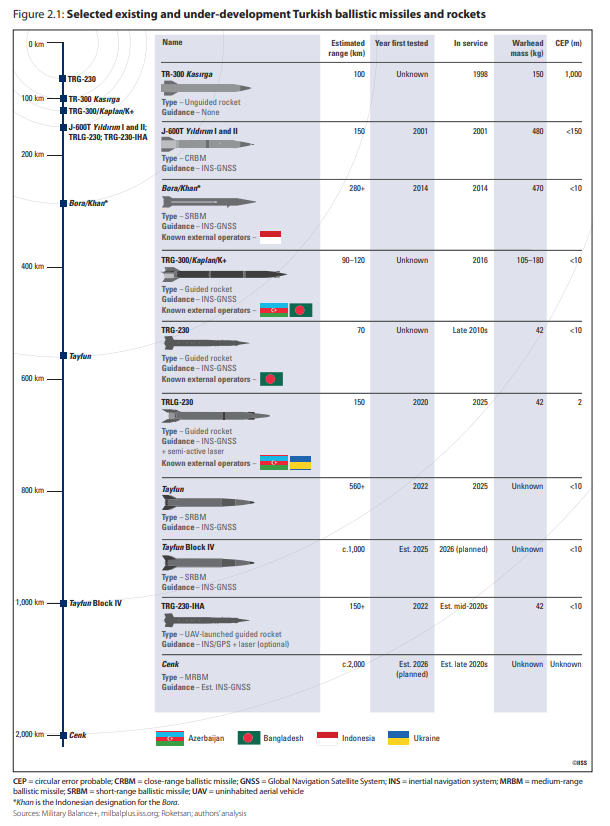
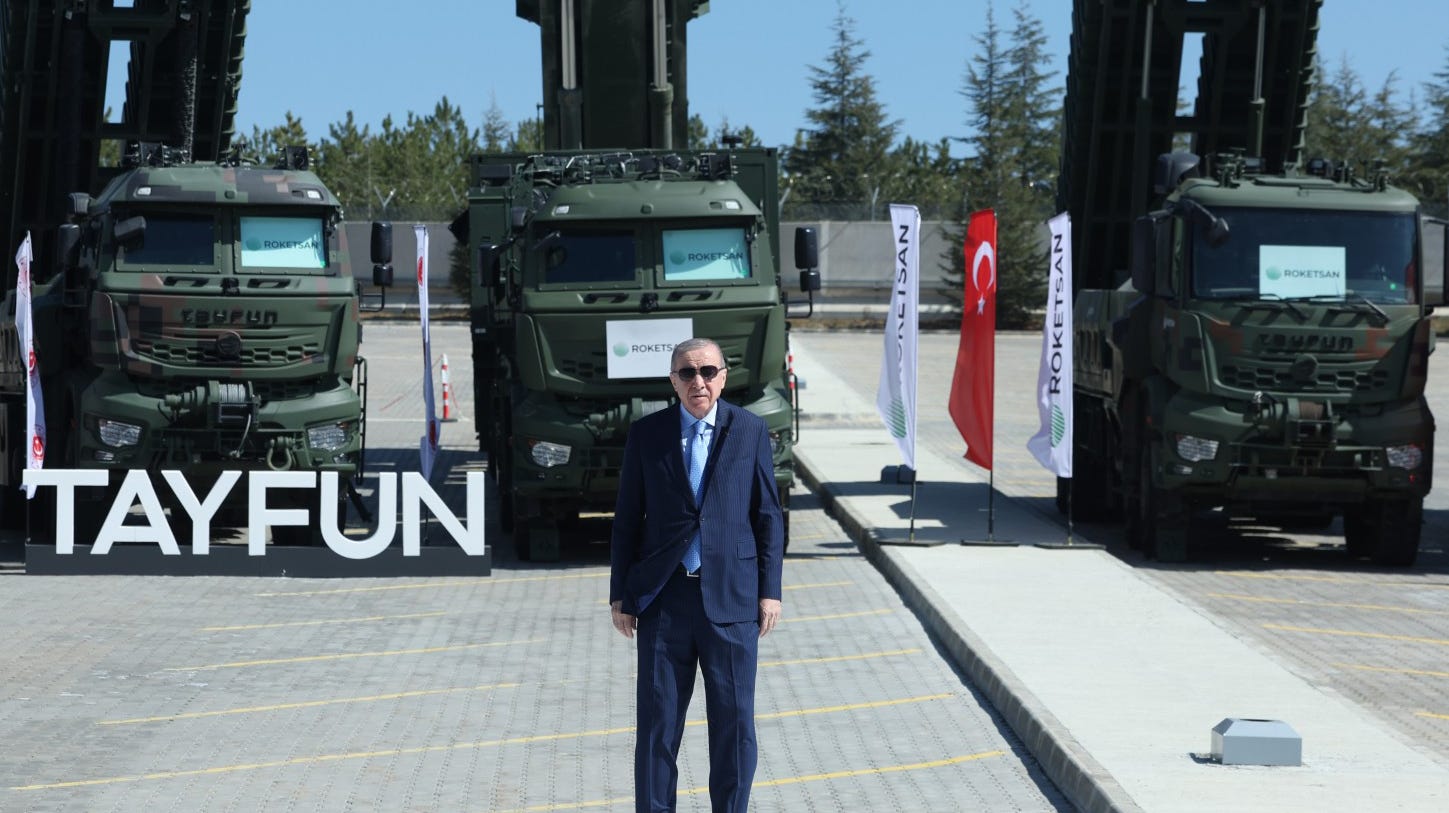
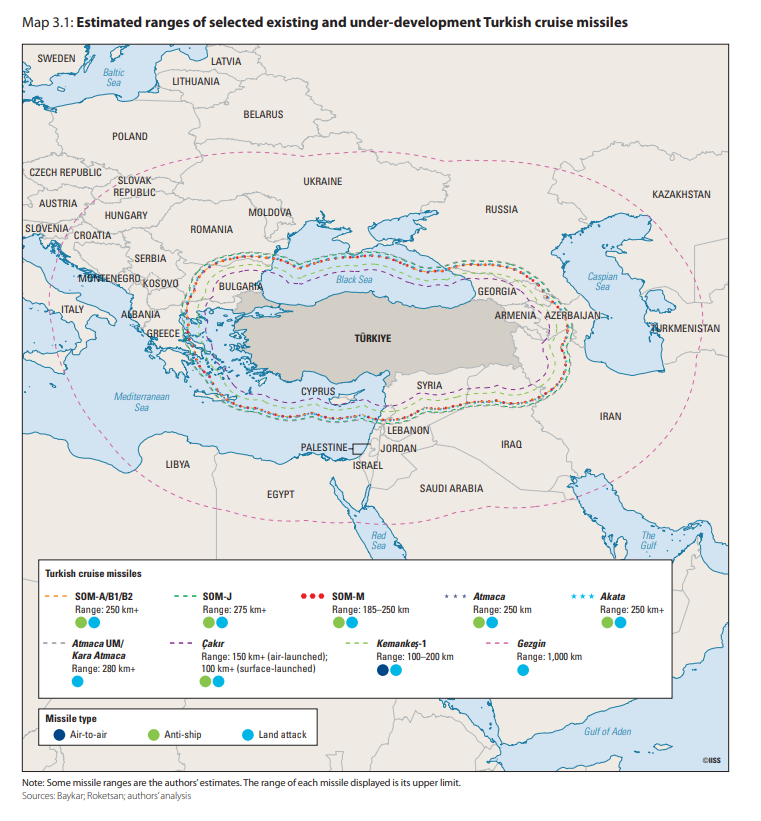
It walks the ladder from the Sakarya artillery rocket through the J-600T Yıldırım, the Bora and the Tayfun family, the Cenk MRBM, and the cruise-missile portfolio centred on the SOM, Atmaca, Akata, Çakır, and Gezgin.
The paper closes by noting that Turkey’s guided-weapons sector is now “nearly unrecognisable” from where it stood at the start of this century, and that further ballistic, cruise, and hypersonic propulsion R&D is under way.
Seven days after the paper went online, Defence Minister Güler walked into Hall 3 of the SAHA expo and unveiled the Yıldırımhan.
The IISS paper does not mention the Yıldırımhan.
The IISS paper closes its discussion of long-range ballistic systems with the Cenk programme — a notional 2,000-kilometre MRBM whose first flight test had not been confirmed at the time of writing. The Yıldırımhan jumps the ladder. Six thousand kilometres. Three thousand kilograms of payload. Mach 25. Liquid nitrogen tetroxide propellant, four-engine cluster, mock-up size suggesting the Cenk’s airframe scaled by roughly a factor of two.
Ankara has no domestic test range that can accommodate this missile.
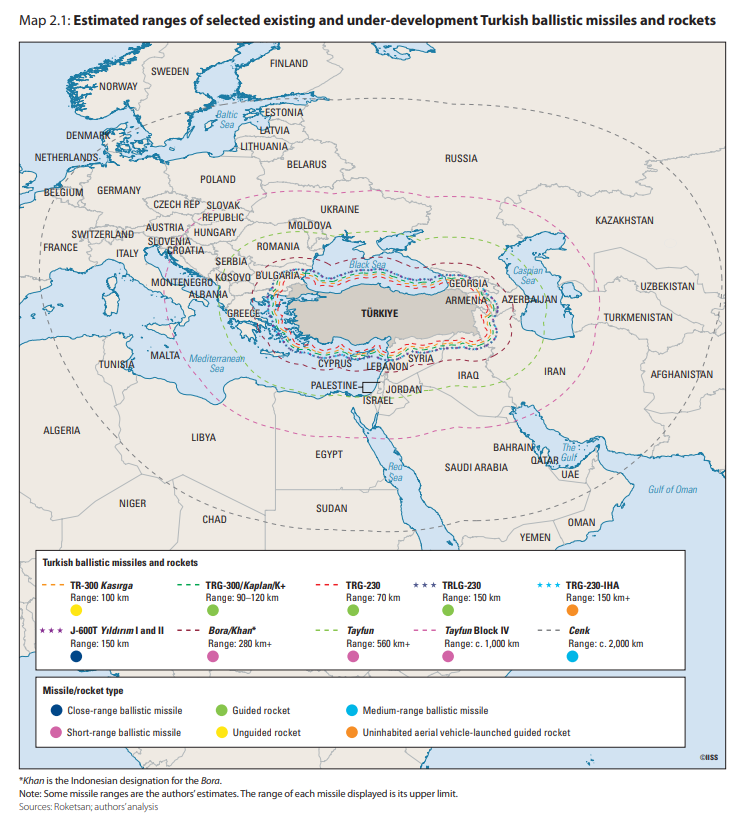
Egeli and Mevlütoğlu flag this point in the paper — Turkey’s existing Black Sea ranges are bounded by less than 1,000 kilometres of clear arc to the western tip of its coast, which is why the Cenk programme has been delayed and why Ankara is investing $350 million in a Somalia spaceport with completion targeted for 2026-27. The Yıldırımhan, by Bloomberg’s 6 May reporting, will be test-fired from the Somali site starting in autumn. The state minister of foreign affairs in Mogadishu, Ali Mohamed Omar, characterised the partnership as primarily civilian — satellites, communications, climate monitoring, education. The Bloomberg sources characterised it as a missile range.
Both characterisations are correct. The technology overlaps exactly.
I want to argue four things about why this missile, at this moment, in this hall, matters.
The first is what it tells you about Erdoğan’s view of Iran.
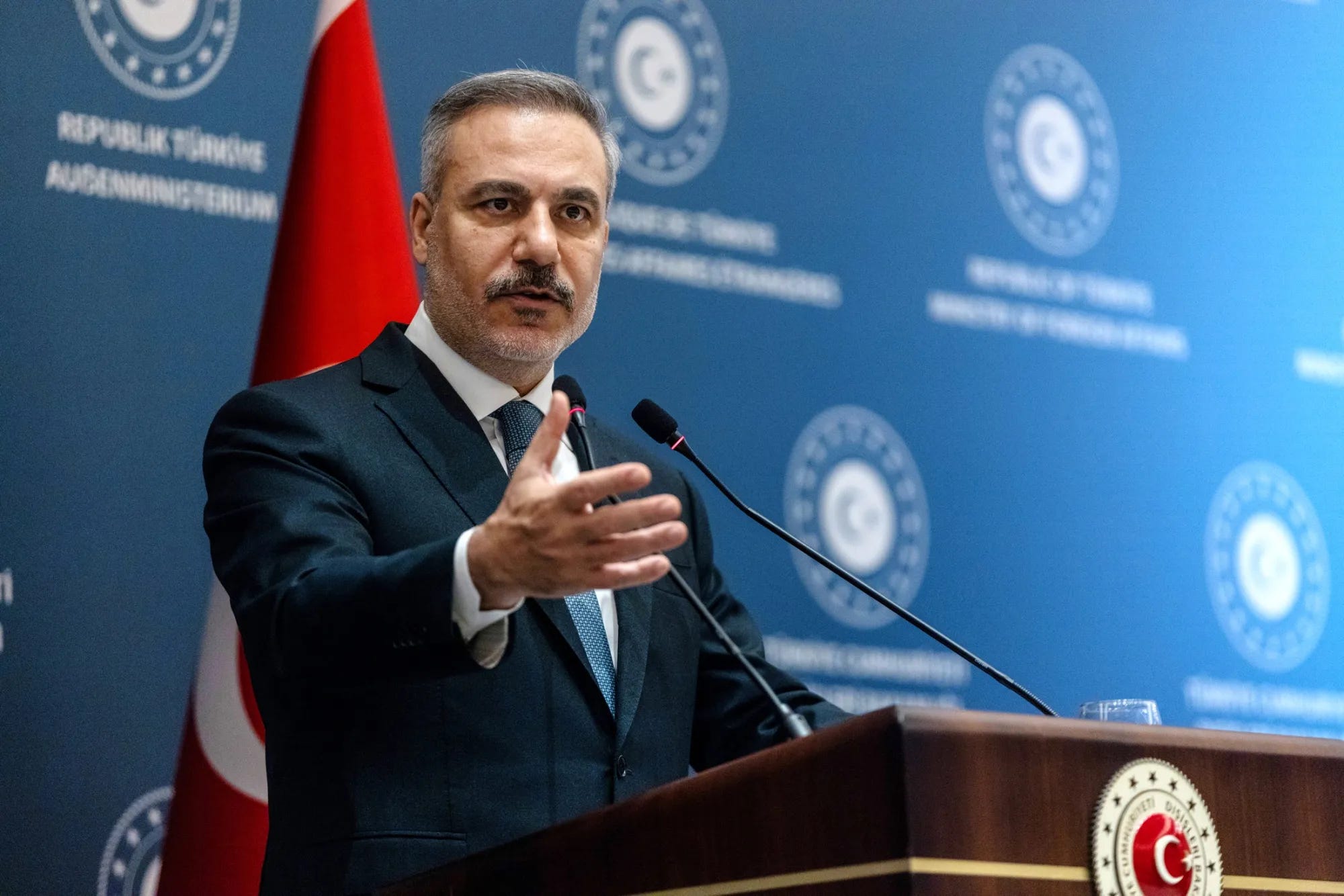
He did not say Turkey would acquire nuclear weapons.
He said Turkey could be drawn in.
The Yıldırımhan is the conventional answer to that statement. A 6,000-kilometre conventionally armed missile with a heavy bunker-busting warhead is the kind of system that lets a non-nuclear state hold strategic targets at risk without actually building a bomb — the same logic that drove Iran’s own conventional ballistic missile programme over the last fifteen years.
Israel reads this correctly: Israeli analyst Shai Gal told Greek City Times that Turkey is not building missiles to defend its territory but building range to determine who lives under Turkish pressure.
The second is what it tells you about Erdoğan’s view of NATO.
The 7-8 July Ankara summit will be the second NATO summit Turkey has hosted, after Istanbul 2004. The 2025 Hague summit committed allies to the 5%-of-GDP defence-spending target by 2035.
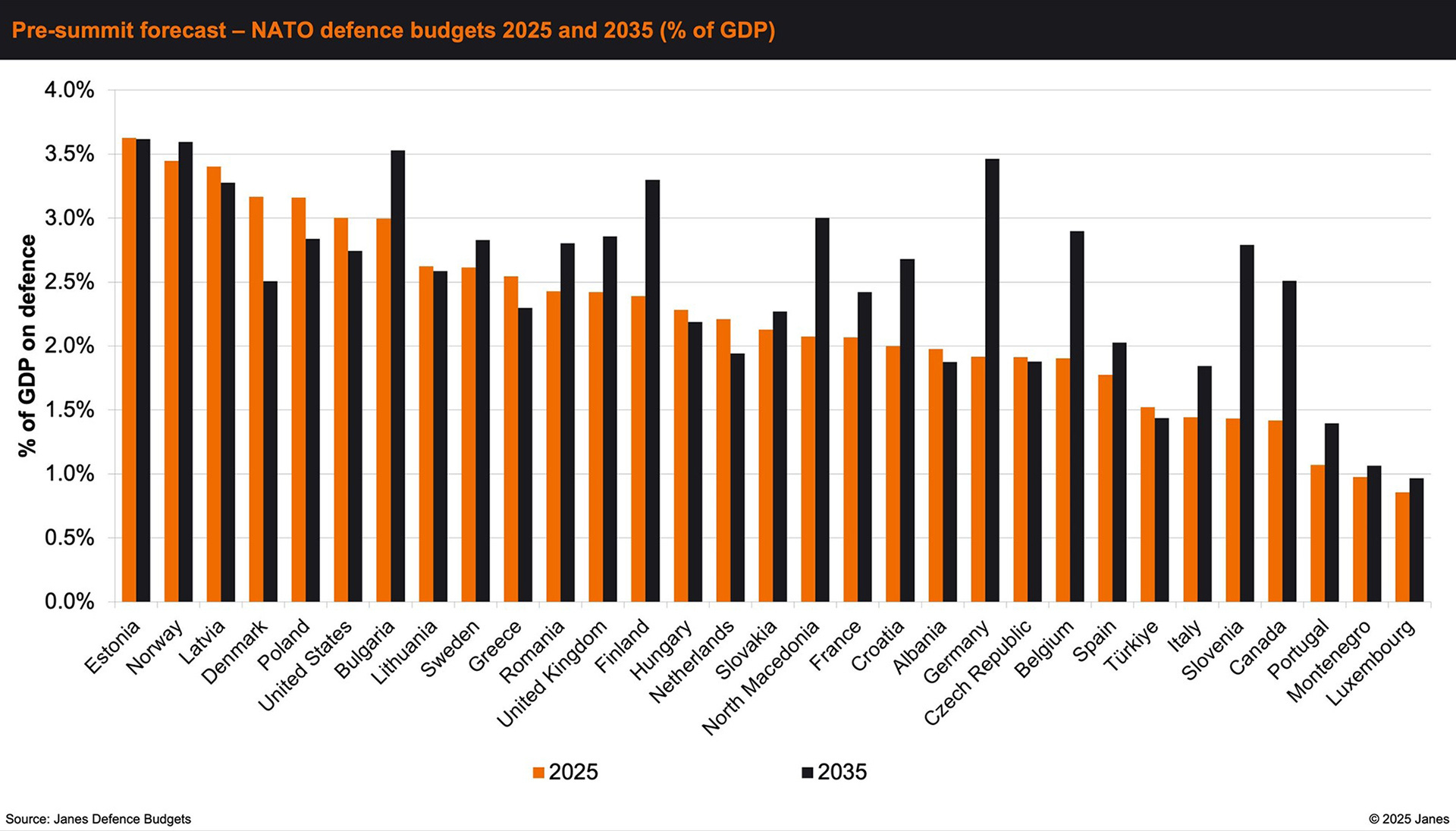
The Yıldırımhan unveil two months before that summit is a stage prop.
It is the alliance’s strongest non-American long-range strike capability arriving on the host’s table.
The third is what it tells you about the F-35 question.
The Foundation for Defense of Democracies has argued, correctly, that re-entry would be dangerous and that Turkey’s ties to Russia’s defence industry remain an unresolved liability.
But the Yıldırımhan reframes the conversation.
Turkey is no longer asking for F-35 because it cannot field a credible top-tier strike capability without it. Turkey is asking for F-35 from a position where it is building strike capability outside the F-35 envelope.
The negotiating leverage runs the other way.
The fourth is what it tells you about Somalia.
Ankara has had its largest overseas military base in Mogadishu since 2017.
Turkish forces train roughly a third of the Somali National Army. The 2024 hydrocarbon-exploration agreement gives Ankara extensive offshore oil and gas rights along the Somali coast. The spaceport was announced as a civilian-and-defence dual-use facility in late 2024. With the Yıldırımhan now on the public docket, the Somalia base is no longer a counter-terrorism logistics hub or an anti-Shabaab platform.
It is a strategic forward-operating geography for Turkish power projection into the Indian Ocean and the Horn of Africa. East African defence customers — Niger, Ethiopia, Togo, the Sahel cluster — already buy Bayraktars.
The infrastructure to test, deploy, and demonstrate longer-range systems from Mogadishu changes what Ankara can sell, to whom, on what timeline.
Egeli and Mevlütoğlu close the IISS paper by noting that Turkey’s political leadership “sees clear value in holding a credible and increasingly long-range inventory of ballistic and cruise systems for deterrence and, should that fail, for war.”
Seven days later Güler said precisely this in Hall 3 — that the deterrent purpose is primary, but that nobody should doubt the willingness to use it.
The Yıldırımhan is not a weapon yet.
It is a mock-up.
Erdoğan is reading the moment correctly.
The unipolar security guarantee is cracking.
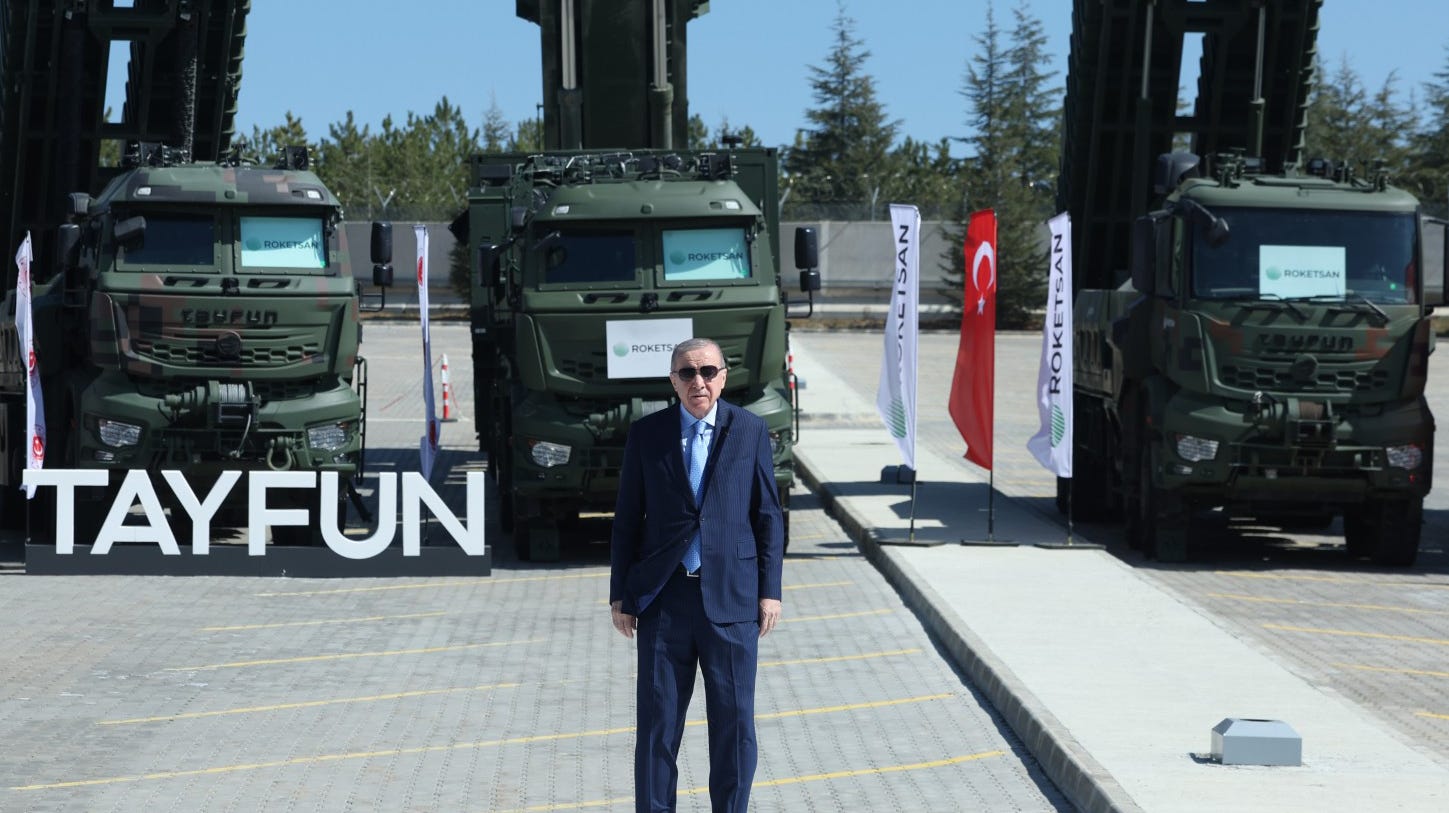
The states that arrive at the cracking point with their own strike portfolio in hand are the states that get to set terms. Hall 3 was the announcement.
The terms are being set.
The Electrification Paradox
Moritz Zackariat’s IPC-Mercator commentary from late April makes a clean argument: Turkey’s energy transition is not primarily a climate strategy but a resilience strategy. Renewables substitute domestic generation for imported fossil fuels. Imported fossil fuels expose the macroeconomy to geopolitical shocks.
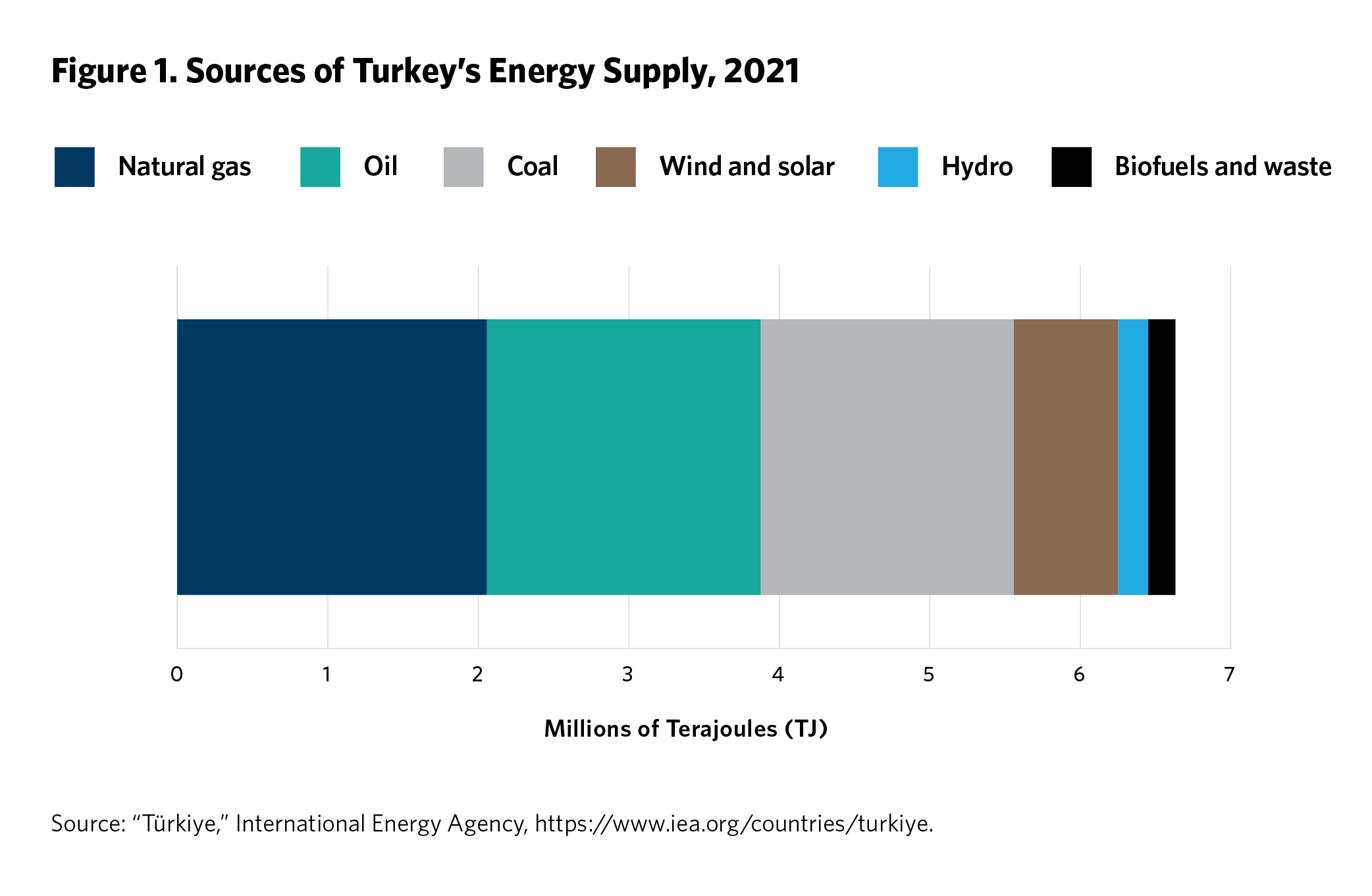
Therefore the transition is, at its core, an industrial-and-resilience play, with climate as a secondary benefit.
The commentary lays out the textbook case.
Turkey imports more than 70% of primary energy.

Negative supply shocks force emerging-market central banks into the policy trade-off, I have written about repeatedly — contain inflation without dampening growth, with less fiscal and monetary space than developed peers. The renewable build-out, by displacing imports, lowers exposure to these dynamics. The merit-order effect lowered Turkish household electricity bills by 9% in 2025.
The resilience case is real.
I agree with Zackariat on the mechanism.
I want to argue that the policy implication is more contested than the commentary lets on — because Turkey’s energy strategy contains a paradox that the resilience frame does not resolve.
The paradox is this.
The energy-hub ambition the war section walked through — the Iraq Development Road, the Kirkuk-Ceyhan reactivation, the Qatari-gas-via-Turkey pitch, the TurkStream surge — depends on imported fossil fuels remaining the centre of Eurasian energy flows. If those flows become unattractive (because renewables displace them at scale, or because European demand collapses), the hub strategy loses its customer base.
Turkey’s transit-economy revenue depends on the continuation of the system that the resilience strategy is designed to escape.
This is not theoretical. It is operational right now.
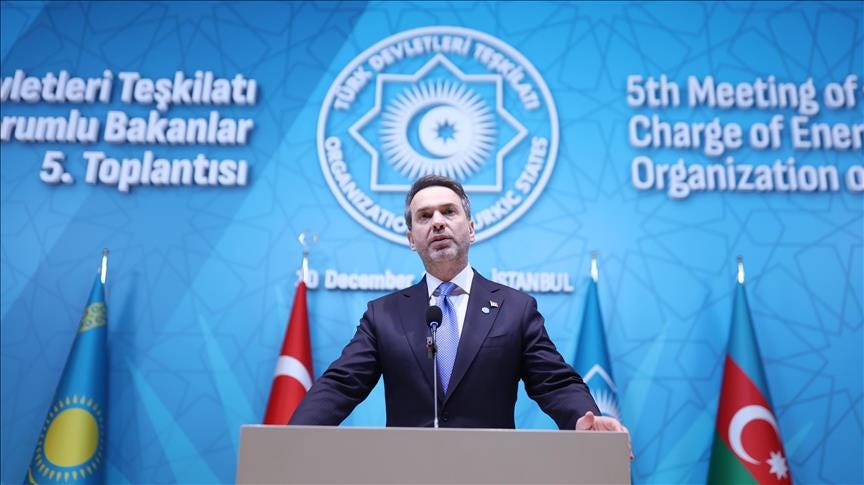
Bayraktar’s October pitch in Moscow about Turkey as “Europe’s energy bridge” was made in the same speech as the long-term plan for 12 large-scale reactors plus 5 GW of small modular reactors — all of which require fuel-cycle partnerships, all of which Russia is positioned to provide, all of which deepen the dependency the renewable build-out is supposed to reduce.
What Turkey actually has is not a single energy strategy but two strategies running in parallel, each rational on its own terms, each undermining the other’s premises.
The hub strategy is reflexive in the sense the war section mapped.
It depends on the war and the disruption.
It depends on Hormuz being dark and the Gulf needing pipelines and the European customer accepting that Russian gas via Turkey is more politically palatable than Russian gas via Nord Stream.
The strategy works if and only if the regional energy architecture stays unstable.
The longer it stays unstable, the more capital is committed to the hub model, the more the hub model becomes an institutional fact, the more the fact constrains future policy.
The resilience strategy points in the other direction.
It works if and only if the regional energy architecture stabilises around domestic generation and electrified end-use. The longer the transition runs, the more capital is committed to the renewable model, the more the renewable model displaces fossil-import flows, the more it undermines the hub.
Erdoğan is committing to both.
The commitments are not equally weighted — the hub strategy has more political mass right now because the war has made the case immediate and the revenue stream visible — but they are simultaneous, and the institutional infrastructure for each is being built in real time.
Zackariat’s commentary frames this as a positive synergy.
I read it as a structural tension that will eventually have to be priced.
Turkey cannot indefinitely be both Eurasia’s pipeline crossroads and a regional renewable champion. At some point — perhaps not this decade, perhaps not next, but eventually — the strategies will converge or one will dominate, and the price for not having chosen will fall due.
For now, the parallel commitment is itself the trade.
It is the energy-policy version of the hybridity premium.
Erdoğan is selling, to multiple customers simultaneously, the option not to commit.
The European Union pays for the renewable trajectory.
Russia pays for the hub.
Saudi Arabia pays for both.
The Gulf monarchies pay for resilience-flavoured infrastructure that doubles as transit infrastructure.
The optionality has a cost.
The cost is that none of the strategies will be executed at maximum efficiency.
The benefit is that all of them remain available.
This is what merkez ülke looks like, priced to the energy stack.
Two strategies, one country, every customer paying.
The contradiction is not a bug — The contradiction is the product.
The Sentence at the Centre
I want to close with a single argument and a single image.
The argument is that Turkey is not ambiguous. Turkey has chosen.
The choice is the seam — and the seam is a strategy with a doctrine, an industrial base, a foreign policy framework, a defence portfolio, a regional alliance architecture, and an energy stack. It is not the absence of a choice. It is a choice that the binary lens cannot see because the binary lens was trained on a world that ended.
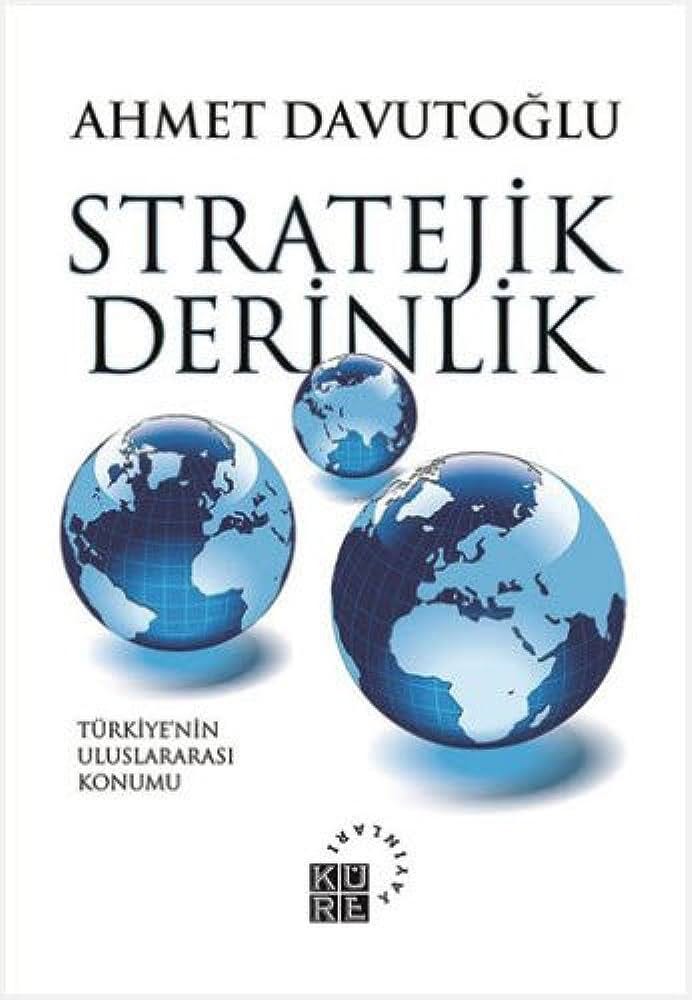
The image is from Davutoğlu’s Strategic Depth, the 2001 book that has shaped Turkish foreign policy for twenty-five years even after Davutoğlu himself fell out of Erdoğan’s circle.
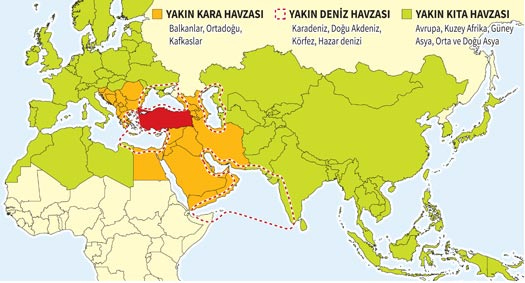
Davutoğlu argued that Turkey is not a peripheral state on the edge of Europe. Turkey is a merkez ülke — a central state — whose value derives from its location at the intersection of historical and geographical hinterlands, and whose role is to be the connective tissue between systems that would otherwise have to negotiate at distance.
The phrase has been derided as neo-Ottoman fantasy.
Turkey has chosen. The choice is the seam. The seam is paying.
The customers are paying because the cost of letting the seam close is higher than the cost of indulging it.
This is what every Western analytical frame that treats Turkey as a problem to be resolved misses.
Turkey is not a problem. Turkey is in a position.
The position is held by a composer whose toolkit is hybrid, whose doctrine is hybridity itself, and whose strategic competence consists in keeping the hedge open while the customers — all of them — keep paying.
The Yıldırımhan does not need to fly to make the point.
The Saudi-Pakistan-Turkey trilateral does not need to be signed to make the point.
The Iraq Development Road does not need to be operational to make the point.
The energy hub does not need to be definitive to make the point.
The point is being made by their existence as live options held simultaneously inside a single national strategy, by a leader committed to four ideological traditions at once, in a country that sits where the maps say it sits.
What changes after 11 May is what happened on 28 February — the unipolar order failed a stress test in the most visible way it has failed since the end of the Cold War.
The states whose strategic posture was built around assuming the unipolar order would hold are now adjusting.
The states whose strategic posture was built around the seam — assuming, correctly, that the order was already multipolar in fact even when it remained unipolar in language — are now executing.
Turkey is executing. Has been executing.
Will continue executing through the NATO summit in July, through the autumn Yıldırımhan test in Somalia, through the next iteration of the trilateral defence platform, through the next Erdoğan Gulf swing, through the ten-week war that has not yet ended.
The composer is at the centre. The traditions hold. The seam pays.
The toolkit is open on the desk.
That is the trade.
Your excellent discussion was most informative and enlightening. My limited understanding of Turkey’s geopolitical situation and strategic positioning has been greatly enhanced and it now has a seam running through it: before and after this article. I am wondering though why you chose not to use the spelling, Türkiye?
Superb article, explains a lot. We visited Istanbul for 9 days last year and I was exceptionally impressed with the culture and the system. They process arguably more tourists from more different corners of the world than any other country. Turkish Airways flies to more different other countries than any other airlines. There are ATM`s on the corner that can deliver Euros, Lira, or US dollars, as you like. The Muslim centers clearly stress the central belief that "God is Love". Your article ties it all together. The Hagia Sofia is an architectural masterpiece, for 1500 years the largest interior space built by man anywhere, and its still in use today, and the line of tourists going through it is incredible, even for someone who grew up around Washington DC. There is a green highway sign, not too big, at the end of the suspension bridge that states simply, "Welcome to Asia"
https://www.flickr.com/photos/167129605@N05/albums/72177720328203700/